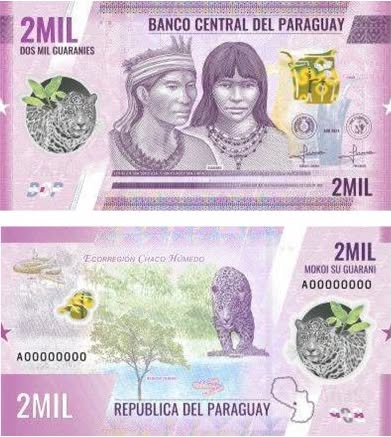
On Monday, October 5, 2026, the Banco Central del Paraguay (BCP) officially unveiled a redesigned family of Paraguayan Guaraní banknotes, marking one of the most significant changes to Paraguay's circulating banknotes in more than six decades. The new series preserves the existing six denominations while introducing new designs, updated security features, new dimensions and a strong emphasis on Paraguayan history, culture and biodiversity.
The new banknotes emphasize Paraguay's extraordinary biodiversity. The BCP's biodiversity project selected representative flora and fauna from Paraguay's different ecoregions for incorporation into the new banknote family. The selected species include the bell bird, giant otter, jaguar, tagua, rainbow bull, yacaré, butterfly, lapacho and other native species. This gives the new series an interesting dual character: Paraguayan history and people on the front, and the country's natural heritage on the reverse.
Another major change is the introduction of different lengths for the denominations while maintaining the same width. The notes will decrease progressively in length according to denomination, with approximately 7 mm between successive denominations. This design is intended to make it easier for people with visual disabilities to distinguish between different values.
The lower three denominations are printed on polymer and the higher three denominations are printed on paper.
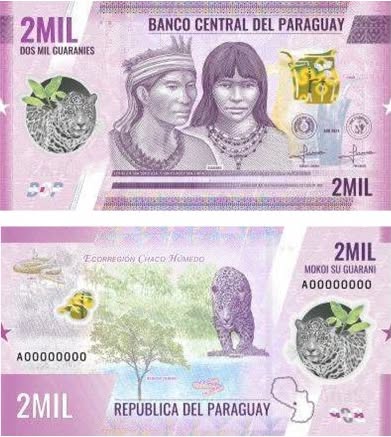
The 2,000-guaraní note pays tribute to the indigenous peoples of Paraguay, highlighting their cultural heritage and contribution to the country's identity. The reverse portrays the jaguarete, the largest feline in the Americas. This banknote is printed on a polymer substrate
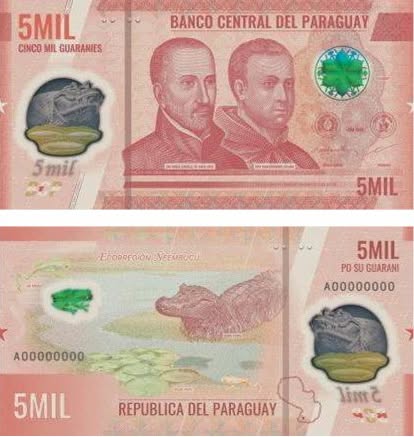
The 5,000-guaraní note represents the legacy of the Paraguayan missions. It features Roque González de Santa Cruz and Fray Juan de San Fernando, remembered as an important figure in Paraguay's religious and cultural history. Roque González de Santa Cruz (1576-1628) was a Guaraní-Spanish Jesuit priest who was the first missionary among the Guaraní in Paraguay. He was murdered in 1628 and is venerated as a martyr and a saint by the Catholic Church. Fray Juan de San Fernando (1569-1594) is considered the first Franciscan born in Paraguayan territory who assisted in the evangelization of indigenous peoples. The reverse portrays the jakare ovéro, an indigenous crocodile, and the jakare yrupẽ, native aquiatic plant with large floating circular leaves. This banknote is printed on a polymer substrate.
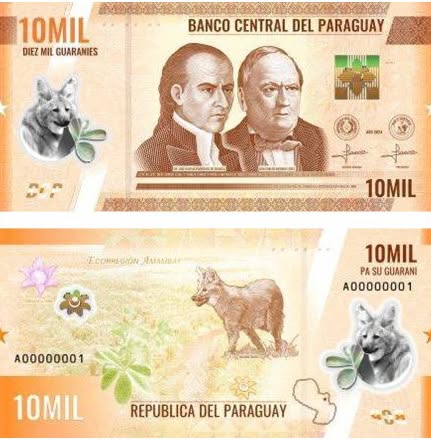
The 10,000-guaraní note features José Gaspar Rodríguez de Francia and Carlos Antonio López, two major figures in the formation and early development of Paraguay as an independent nation. José Gaspar Rodríguez de Francia (1766-1840) was a lawyer, politician, statesman and the first dictator (1814–1840) of Paraguay following its 1811 independence from the Spanish Viceroyalty of the Río de la Plata. Carlos Antonio López (1792-1862) was leader of Paraguay from 1841 to 1862. Under his presidency, he undertook a process of economic and political modernization for Paraguay, and ended the isolationist policies of Paraguay dictator José Gaspar Rodríguez de Francia. The reverse portrays the maned fox (Chrysocyon brachyurus), the largest canine in South America, the earth star (Geastrum saccatum), a species of mushroom, and the katuáva (Psidium grandifolium), a deciduous shrub growing less than 2 meters tall bearing fruit. An important change for this denomination is that the new 10,000-guaraní note is printed on polymer, expanding the polymer portion of the Paraguayan banknote family.
The introduction of the new banknotes will be carried out gradually, in accordance with the cash replenishment needs. The older design banknotes will be gradually withdrawn according to their deterioration and natural circulation cycle. The new banknotes will co-circulate along with the current ones indefinitely.
Donald Ludwig, October 6, 2026